In this article: Learn Florida milestone inspection requirements, timelines, and costs. A clear guide for condo boards on what to expect and how to prepare.
If you’ve recently received a notice about a milestone inspection, or you know your building is approaching that age, you’re probably trying to piece together what this actually means for your association.
If it feels a bit unclear, that’s normal.
Most boards are going through this process for the first time. The requirements are specific, the timelines matter, and the terminology isn’t always intuitive. So instead of approaching this as a checklist, it helps to walk through the process the same way you’re likely experiencing it: one question at a time.
What exactly is a milestone inspection in Florida?
At its core, a milestone inspection is a structural inspection of an aging building.
The purpose isn’t to evaluate finishes, maintenance, or appearance. It’s to determine whether there is substantial structural deterioration. In other words, are the building’s structural systems still performing the way they’re supposed to?
This requirement comes from Florida’s building safety legislation, specifically Section 553.899 of the Florida Statutes, which establishes a consistent, statewide approach to structural inspections of aging condominium buildings.can be achieved without unnecessary delays or surprises.
Does our building actually need a milestone inspection?
This is usually the first question boards ask, and the answer depends on two things: height and age.
If your building is a condominium or cooperative that is three stories or higher, it falls under the requirement once it reaches a certain age. That threshold is typically 30 years, or 25 years in coastal areas where local authorities require earlier inspections. From that point forward, the inspection must be repeated every 10 years.
One detail that often gets overlooked is how the building’s age is determined. It’s based on the certificate of occupancy, not when the association was formed.
Note: Some cities and counties have stricter local requirements than the statewide milestone law. In certain cases, factors like building height can affect inspection rules—learn more in our article on how building height can affect safety inspection rules.
When do milestone inspections need to be completed in Florida?
The law introduced specific deadlines depending on when a building reached 30 years of age. Some buildings were required to complete their inspections by the end of 2024, while others fall into the next deadline at the end of 2025. After that initial milestone, inspections continue every 10 years.
In practice, what matters more than the statutory deadline is what happens once your building is officially notified.
How will we know when our building needs a milestone inspection?
(And how much time do we really have?)

For most associations, the process officially begins when they receive a formal notice from the local enforcement agency, typically your city or county building department.
That notice is not informal. It is sent by certified mail to the association (and any other relevant building owners). Once it’s received, the association is required to notify all unit owners within 14 days.
This is when milestone inspections shift from something you’ve heard about to something you’re officially responsible for completing.
At the same time, another clock starts: Phase 1 of the inspection must be completed within 180 days of the enforcement agency’s notice.
Should we start before we receive a notice?
One of the most common questions we hear is whether it makes sense to wait for the official notice or to start earlier.
In practice, starting early makes a significant difference.
If your building is approaching the required age, you don’t have to wait until the notice arrives to begin planning. Once that notice is received, the timeline becomes fixed, and the 180-day window for completing Phase 1 can close faster than expected.
What many boards don’t expect is how much time can be taken up before the inspection even begins. Getting proposals, selecting an engineer, and coordinating access all take time. In busy periods, engineer availability can become limited.
Starting the conversation early gives you more flexibility. It allows you to:
- evaluate proposals more carefully,
- avoid scheduling bottlenecks, and
- approach the process with less pressure.
For boards that already know their building is due, taking that first step early is often the difference between a controlled process and a rushed one.
Who is responsible for a milestone inspection in a condo association?
Even though individual unit owners are part of the ownership structure, the responsibility for arranging the milestone inspection sits with the association.
That means the board is responsible for hiring the professional, coordinating the process, and ensuring everything is completed on time.
The cost is also handled at the association level. It’s a shared responsibility, not something individual owners manage on their own.
Who is qualified to perform a milestone inspection?
(And how do you choose the right engineer?)
A milestone inspection must be performed by a licensed professional engineer or architect, or a team working under one who takes responsibility for the inspection.
But boards quickly realize that licensing alone isn’t the full picture.
Experience matters, especially when it comes to South Florida buildings. The local environment plays a significant role in how structures age. Salt air, humidity, and coastal exposure can accelerate corrosion and concrete deterioration in ways that aren’t as common in other regions.
An engineer who regularly works in this environment understands where problems tend to develop and how to interpret early signs of deterioration in this specific climate.
Just as importantly, familiarity with local jurisdictions and inspection requirements can make the process more efficient, particularly if a Phase 2 investigation becomes necessary.
What parts of the building are actually inspected?
One of the most common questions is how extensive the inspection really is.
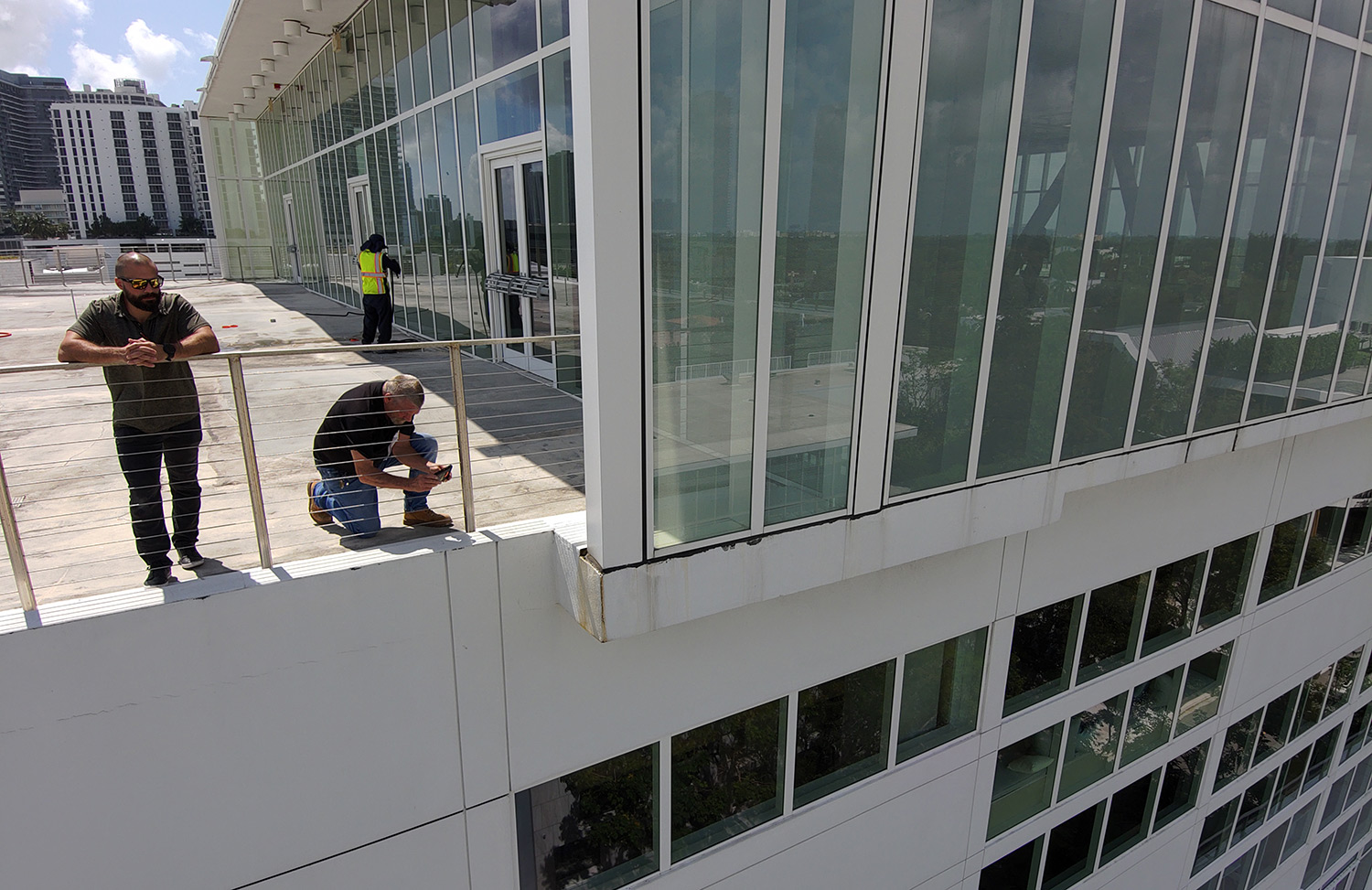
The focus is on the structural systems of the building: the elements that carry load and ensure stability. That includes components like slabs, columns, load-bearing walls, balconies, and foundations.
It’s not a cosmetic review. Surface-level issues like cracked paint or finishes are not the focus unless they indicate something structural beneath. And while common areas are the primary focus, access to certain units, especially where structural elements like balconies are involved, may be necessary.
What does the milestone inspection process look like (Phase 1 and Phase 2)?
The process is divided into two phases, though not every building will go through both.
It starts with Phase 1, a visual assessment of the building’s structural components. The goal is to determine whether there are signs of substantial structural deterioration.
Once Phase 1 is complete, a report is submitted to the local enforcement agency.
If no concerns are identified, the process ends there.
If concerns are identified, the inspection moves into Phase 2. This second phase is more detailed. It may involve testing materials, exposing structural elements, or performing analysis to confirm whether the building is structurally sound. It also results in recommendations for repair or further evaluation.
Prefer a short overview?
Watch our short introduction to Florida Milestone Inspections and how Building Mavens helps associations navigate the process.
What does a milestone inspection cost, and why does it vary?
This is one of the most common questions boards ask.
The reality is that milestone inspection costs can vary significantly depending on the building. Factors like size, number of stories, accessibility, and whether a Phase 2 inspection is required all play a role.
Because of this, inspections are typically scoped on a case-by-case basis, rather than priced as a fixed service.
For boards, the most useful first step is understanding the scope, because that’s what ultimately determines cost.
Will a milestone inspection find everything wrong with the building?
This is an important expectation to set early. A milestone inspection is designed to evaluate structural integrity. It is not intended to identify every issue in the building.
That means items like finishes, waterproofing details, mechanical systems, or smaller maintenance concerns are generally outside the scope, unless they directly relate to structural performance.
It also means that hidden conditions (issues that don’t present visible indicators) may not be identified during a visual inspection.
Understanding this helps avoid a common misconception: This is not a full building audit. It’s a targeted assessment focused on structural safety—a snapshot of the building at a specific moment in time.
A milestone inspection is not a full building audit. It’s a targeted, visual assessment of structural safety. A snapshot of the building at a specific moment in time.
What is included in a milestone inspection report?
The milestone inspection report is a structured document defined by law.
It outlines what was observed, how the inspection was performed, and whether substantial structural deterioration was identified. It also addresses whether any unsafe conditions exist and what actions are recommended.
A separate summary of findings is prepared specifically for unit owners, and the report must be signed and sealed by the licensed professional responsible for the inspection.
What happens after the milestone inspection is completed?
Once the association receives the report, there are immediate next steps.
The law requires that the summary report be distributed to all unit owners within 45 days. It must also be posted in a visible location, and if the association maintains a website, both the summary and full report must be published there.
This ensures that all owners (not just the board) have access to the results.
What if repairs are required after a milestone inspection?
If the inspection, particularly Phase 2, identifies structural deficiencies, the association must act. Under Florida law, repairs must be commenced within 365 days of receiving the report, unless the local jurisdiction requires action sooner.
Once those repairs are completed, the building must be reinspected, and an updated report must confirm that it is safe for continued occupancy.
Can we get more time to complete a milestone inspection?
In some cases, yes. An extension may be granted if the association can demonstrate that it has already engaged an engineer or architect but cannot reasonably complete the inspection before the deadline.
These extensions must be requested and justified; they are not automatic.
Why do milestone inspections feel more complicated than they are?
For many boards, milestone inspections feel complex not because the process itself is unclear, but because it introduces firm timelines into something that was previously more flexible.
There are deadlines. Reporting obligations. Legal responsibilities.
But when you step back, the process follows a logical path: Receive notice, complete the inspection, understand the findings, and act if needed.
What are the next steps for condo boards?
If you’re at the beginning of this process, the most important step is understanding where your building stands in terms of age and deadlines. From there, everything else becomes easier to plan.
If you’ve already received notice, starting early gives you more control, not just over scheduling but over the decisions that follow.

FAQs: Florida Milestone Inspections
Introduced by the Florida Legislature, this statute addresses mandatory structural inspections for condominiums and cooperative Buildings. Learn more about Statue 553.899 here.
A Milestone Inspection is a thorough examination of a building’s structural integrity, conducted by licensed architects or engineers in Florida. This process involves assessing the building’s load-bearing components and major structural elements as outlined in statute s. 627.706. The professionals responsible for this inspection focus on confirming the safety and longevity of the building’s structure, identifying any parts that might need maintenance, repair, or replacement. Typically, these inspections are done by a team of specialists led by an architect or engineer. The team leader ensures that all findings and reports are officially approved and documented by the team’s qualified members.
It’s important to note that the aim of this inspection isn’t to check if the building complies with the Florida Building Code or fire safety codes, but rather to evaluate its structural condition.
Structural deterioration is substantial structural distress that negatively affects a building’s general structural condition and integrity. It does not include surface imperfections such as cracks, distortion, sagging, deflections, misalignment, signs of leakage, or peeling of finishes.
All condo buildings 3 stories or more in height must have a Milestone Inspection performed for each building by December 31st of the year in which the building reaches 30 years of age based on the Certificate of Occupancy (CO). A further Milestone Inspection is required for each building every 10 years thereafter.
First and foremost, given Florida’s humid climate and severe weather conditions, these inspections play a vital role in ensuring the structural integrity and safety of your building. This is not only to prevent costly repairs in the future but also to extend the lifespan of the building. The importance of these inspections is further underscored by the fact that they are required by law.
Beyond these practical considerations, the Florida Legislature has highlighted the importance of maintaining a building’s structural integrity throughout its life as paramount. This is because structurally sound buildings are essential for the safety and welfare of the public. Recognizing this, the Legislature has found it necessary to impose a statewide structural inspection program specifically targeted at aging condominium and cooperative buildings. This program aims to ensure these buildings are safe for continued use, reflecting a broader commitment to public health, safety, and welfare. Read more in our dedicated Senate Bill 154 Milestone Inspection article.
If your building is subject to these codes, the building must have its first milestone inspection performed by December 31 of the year in which the building reaches 25 or 30 years of age, based on the date of the certificate of occupancy for the building was issued and local enforcement agency expectations, and every 10 years thereafter.
- As of the current legislation (Florida Statute 553.899), buildings that are 30 years or older, with a Certificate of Occupancy issued before July 1992, must complete a milestone inspection by December 31, 2024, and have inspections every 10 years.
- If a building reaches 30 years of age on or after July 1, 2022, and before December 31, 2024, the building’s initial milestone inspection must be performed before December 31, 2025.
- If the date of issuance for the certificate of occupancy is not available, the date of issuance of the building’s certificate of occupancy shall be the date of occupancy evidenced in any record of the local building official.
If your building is subject to certain environmental conditions such as proximity to salt water or placement within three miles of a coastline as defined in Statute 379.101, it may be required to first receive its first milestone inspection at 25 years of age and every 10 years thereafter. Check with your local enforcement agency to confirm inspection timing for your building.
Milestone inspections are primarily concerned with the critical structural elements of a building. This includes:
- Foundation: Ensuring the stability of the building’s base.
- Load-bearing walls: Assessing the integrity of walls responsible for supporting the structure’s weight.
- Shear walls: Evaluating walls designed to withstand lateral forces, crucial for stability.
- Roof deck: Ensuring the safety and integrity of the roof structure.
- Balconies: Examining balconies for structural soundness.
“Substantial structural deterioration” is the key phrase for what inspectors are looking for. It means substantial structural distress or substantial structural weakness that negatively affects a building’s general structural condition and integrity. The term does not include surface imperfections such as cracks, distortion, sagging, deflections, misalignment, signs of leakage, or peeling of finishes unless the licensed engineer or architect performing the phase one or phase two inspection determines that such surface imperfections are a sign of substantial structural deterioration. Learn more in our dedicated article about Milestone Inspection legislation in Florida.
While Milestone Inspections are thorough, they focus on structural and major system integrity. They may not catch all minor issues, but they are designed to identify significant potential problems that could impact the safety and performance of your building.
An architect licensed under chapter 481 or engineer licensed under chapter 471, authorized to practice in Florida. The milestone inspection services may be provided by a team of professionals with an architect or engineer acting as a registered design professional in responsible charge with all work and reports signed and sealed by the appropriate qualified team member. Experience in the Florida building industry and knowledge of local codes and standards is also essential. All engineering resources at Building Mavens are qualified Florida building inspectors.
During the first phase of a structural evaluation (Milestone Inspection) evaluation, a licensed architect or engineer will visually check both the living and non-living areas of a building, focusing on its main structural parts. They’ll provide a qualitative assessment about the building’s structural health. If they don’t find any serious structural issues, there’s no need for a second phase of inspection. The architect or engineer will then write and submit an official inspection report on their findings.
However, if substantial structural deterioration is uncovered during the first phase, a more in-depth second phase of inspection is needed. This next step may include either destructive or non-destructive testing, based on the inspector’s decision, to thoroughly evaluate any troubled areas to establish the safety level of the building and provide recommendations on how to fix any damage. The inspector will choose test areas that cause the least disruption and are easiest to fix, yet still provide a good overview of the building’s condition. If this second phase is needed, the architect or engineer must, within 180 days after the first phase report, send a progress report to the local enforcement agency outlining when they’ll finish the second phase. After completing the second phase, the inspector must prepare and submit a detailed inspection report.
I received an inspection notification. How much time do I have to complete the milestone inspection?
Phase one of the milestone inspection must be completed within 180 days after the owner or owners of the building receive the written notice. Completion of phase one of the milestone inspection means the licensed engineer or architect who performed the phase one inspection has submitted the inspection report by email, United States Postal Service, or commercial delivery service to the local enforcement agency. The entire phase one process must be done within this 180-day period.
Yes, if a building owner has a valid reason for not being able to finish their first Milestone Inspection on time, they can ask the local enforcement agency for more time. This is possible if the owner has already hired an architect or engineer for the inspection but can’t complete it by the original deadline due to reasonable delays or special circumstances.
If the initial check (phase one) of a building shows substantial structural deterioration, a more detailed follow-up inspection (phase two) is needed. This second stage might include tests that either involve destructive or nondestructive testing based on what the inspector thinks is necessary. This phase may be as extensive or as limited as necessary to achieve the goal of finding any and all signs of structural distress, ensuring the building is structurally sound and safe for its intended purpose and to recommend a program for fully assessing and repairing distressed and damaged portions of the building. The inspector will give preference to test areas that cause the least disruption and are easiest to repair, while still being representative of the structure and condition. If a phase two inspection is required, the responsible architect or engineer must, within 180 days of the phase one inspection report, inform the local authorities of their progress and when they expect to finish the phase two inspection. After completing phase two inspection, the inspector must write up their final report and submit it to the local enforcement agency.
The law introduces the term “habitable stories” but applies it inconsistently. This creates a complex legal question about whether buildings like a two-story-over-garage structure are subject to the initial milestone inspection. The previous standard was “three or more stories,” and that language remains in a key part of the statute. Associations must seek a legal opinion to clarify their status.
The term’s application is complex. While HB 913 introduces the term “habitable story” (defined by the Florida Building Code as space for living, sleeping, eating, or cooking), it applies it to the ongoing 10-year SIRS requirement. A key part of the statute still defines the initial milestone applicability as buildings of “three stories or higher,” without the “habitable” qualifier. Because of this legal nuance, you must consult with your association’s legal counsel for an opinion on your building’s specific situation.
This is not a new deadline, but a new enforcement mechanism. Current law already requires associations to commence repairs within 365 days of a Phase Two report. CS/CS/HB 913 now requires local governments (counties or municipalities) to adopt ordinances that enforce this 365-day deadline, ensuring stricter compliance.
Yes. Design professionals (like architects and engineers) and licensed contractors who bid on performing a Milestone Inspection must now disclose in writing if they also intend to bid on any maintenance, repair, or replacement work that might arise from that inspection. Failing to disclose this can make the inspection contract voidable and could lead to professional discipline.
Local enforcement agencies must report specific Milestone Inspection data to the Department of Business and Professional Regulation (DBPR) by October 1, 2025, including the number of buildings inspected and a list of any deemed unsafe. While this is a duty for the agencies, it means there will be more state-level oversight and data collection on building safety, which could indirectly influence compliance and enforcement priorities.
About the Author
 Scott Harvey-Lewis is the owner and President of Building Mavens, a leading Milestone Inspections and Engineering Consulting firm right here in Palm Beach Gardens, Florida. With over 18 years of experience as a forensic engineer, Scott brings a wealth of knowledge and a passion for ensuring the safety and integrity of buildings. He holds a master’s degree in civil engineering from the University of Florida and a bachelor’s degree in civil engineering from the Florida Institute of Technology. He is also a Licensed Professional Engineer in Florida and a LEED Accredited Professional.
Scott’s background is extensive, covering both public and private projects. He’s highly skilled in structural engineering design, construction oversight, and forensic analysis. This includes investigating structural failures, construction defects, and code compliance – all critical to maintaining safety and adhering to building codes. Beyond his investigative work, Scott is also an accomplished design engineer, contributing to various architectural elements from building envelope systems to designs for a wide range of structures. From the initial concept to the final inspection, Scott is dedicated to providing innovative and compliant engineering solutions.
You can contact me directly for more information: info@buildingmavens.com.